
Key Takeaways
- Recurring revenue is not only subscriptions. For a luxury brand, it is revenue from clients who return without being acquired again.
- Retention compounds. With 1,000 new clients a year, a 40% return rate gives you 25.8% more buyers by year three than a 20% rate.
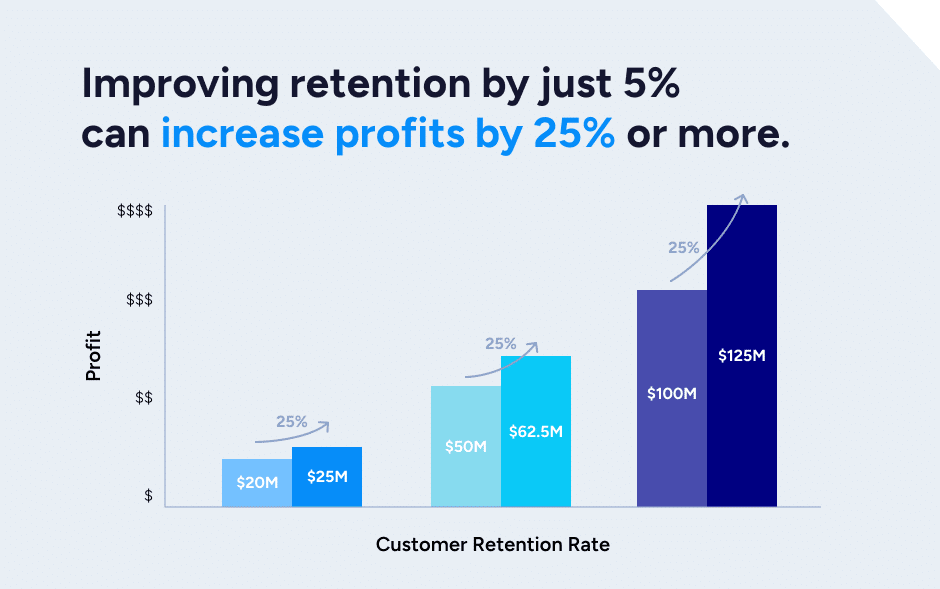
- It protects margin. Raising customer retention by 5% increases profits by 25% to 95%.
- Progress brings clients back. A head start lifted loyalty card completion from 19% to 34%.
- A loop has four parts: trigger, action, reward and investment. Design the unboxing too, because it is the end clients remember.
A deep dive into the psychology of recurring revenue and customer lifetime value for luxury brands.
Imagine a luxury brand at $5M a year. It won 10,000 new clients last year, and 8,000 of them never ordered again.
Before it can grow, it has to pay to replace all 8,000.
A retention loop stops that by making each purchase the reason for the next.
In this guide, I’ll show you how the loop works, why it turns one-time buyers into recurring revenue, and the six parts you need to build one.
What is a retention loop?
A retention loop (or loyalty loop) is a cycle in which one purchase creates the conditions for the next one. It doesn’t just bring a client back once; it makes each return more likely than the one before.
For a luxury brand, recurring revenue does not have to mean a subscription. It is revenue from clients who return without being acquired again.
Forms of retention loops include:
- Replenishment loop: The product runs out and the client reorders. Skincare, fragrance, candles.
- Collection loop: Each piece calls for the next. Jewelry, tableware, leather goods.
- Occasion loop: Gifts and milestones bring the client back on a calendar.
- Service loop: Care, repair and personalization return the product, and the client, to you.
As a brand builds these loops, what once felt like unpredictable repeat sales becomes a structured, learnable system.
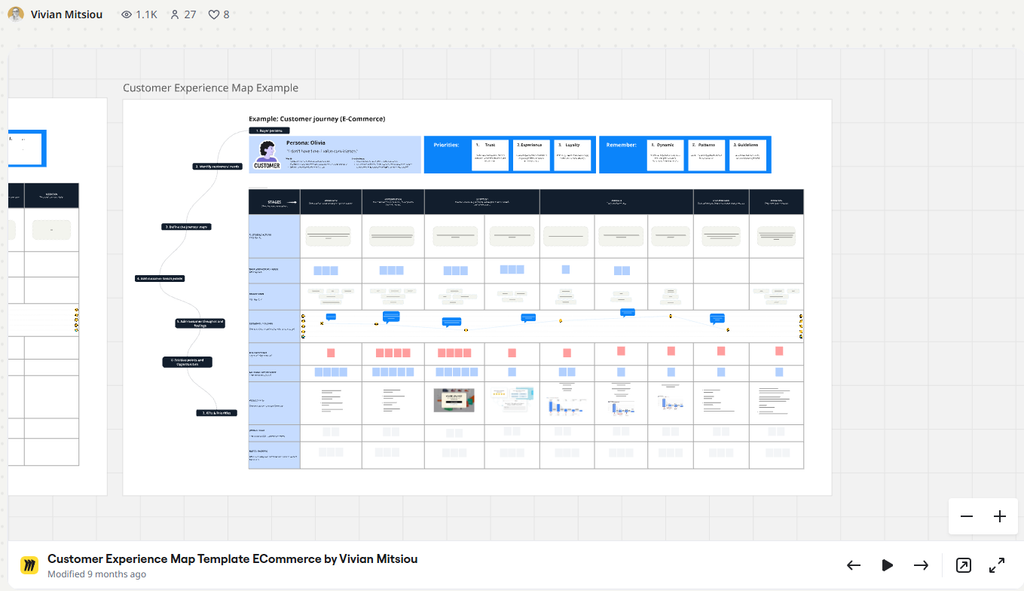
To find your loop, map what clients do after they buy. The template’s Post-purchase and Retention stages are built for this. More about that in a minute.
Why recurring revenue is important past $5M
Acquisition can carry a luxury brand through its first millions. Past that point, growth that depends only on new clients has to be bought again every month.
Recurring revenue is the part of growth you do not have to buy twice. It is also what raises customer lifetime value: the total a client spends across the whole relationship with your brand.
Let’s look at five key benefits of retention loops, and the psychology behind each.
1. Recurring revenue compounds
Imagine you win 1,000 new clients every year. If 20% of last year’s buyers return, you have 1,240 buyers in year three. If 40% return, you have 1,560.
That is 25.8% more buyers from the same acquisition budget. Churn resets your growth every year. Retention compounds it.
And the gap keeps widening. Over time, the first brand settles at 1,250 buyers a year and the second at about 1,667.
2. Recurring revenue protects margin
A returning client costs little to bring back, so more of each order stays as profit.
Take a client who spends $400 per order. If they buy once and leave, they are worth $400. If they return once a year for five years, they are worth $2,400, and you paid to acquire them only once.
Research by Frederick Reichheld of Bain & Company found that raising customer retention by 5% increases profits by 25% to 95% (Harvard Business Review).
3. Progress makes clients come back
In 2004, two researchers handed out 300 loyalty cards at a car wash. Half needed eight stamps. The other half needed ten, with two already stamped. Both groups had to buy eight washes.
After nine months, 34% of the head-start group had earned the free wash, against 19% of the others (Nunes and Drèze, Journal of Consumer Research, 2006).
People finish what they feel they have already started. A luxury brand does not need a stamp card. A started collection, a saved monogram or a first care appointment does the same work.
4. Memory decides the next purchase
Clients do not remember the whole experience. Psychologists call it the peak-end rule: we judge an experience by its high point and its last moment.
In eCommerce Experience Design, the end is not the checkout. It is the unboxing. That is why a loop depends on three things working together:
- Trust: The client is sure the next order will be as good as the last.
- Experience: Expectations are met, and the peak and the end are designed.
- Loyalty: The reason to return is present across the whole journey, not only inside a program.
5. You see where churn starts
Churn rarely starts on the day a client leaves. It starts earlier, at the second order that was never placed. There are tools to find that moment:
- Observe: Cohort reports in your store and email platforms show the time between orders and where it stretches.
- Listen: Post-purchase surveys, reviews and customer service conversations tell you why.
Look first at the gap between the first and the second order. A client who has bought twice has already shown you that the loop works.
Now that you understand why recurring revenue matters, let’s examine the components of a retention loop.
What are the components of a recurring revenue loop?
A retention loop has four steps that happen in order, and two more parts that make the steps work. The four steps come from Nir Eyal’s Hook Model.
To make them concrete, follow one client through all six. She has just bought a perfume from your store.
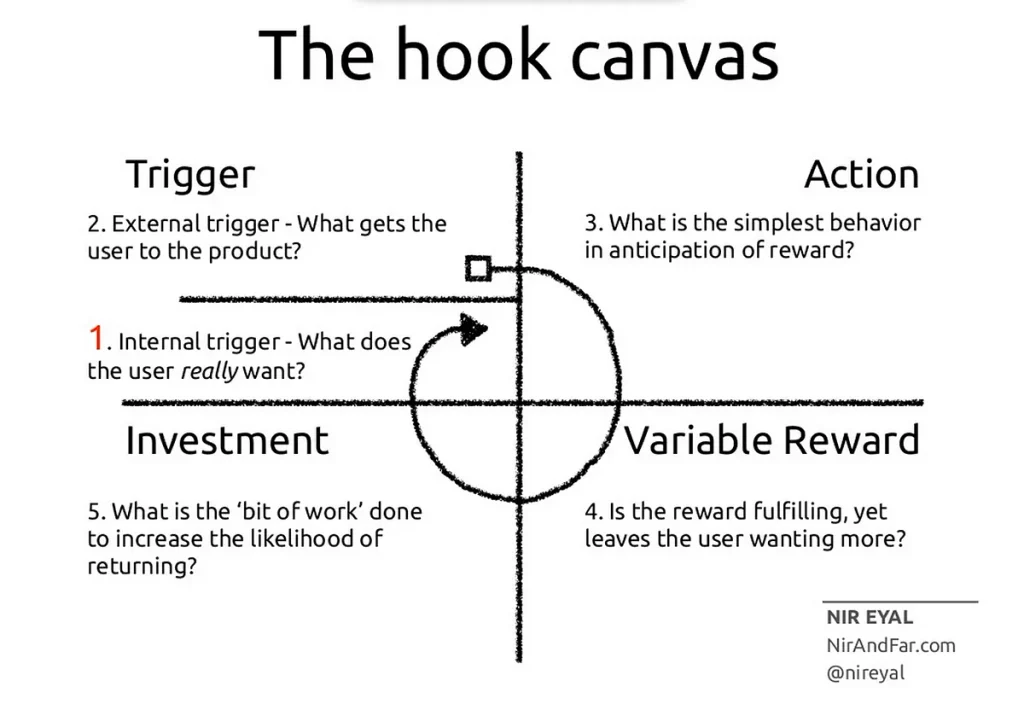
1. Trigger
A trigger is whatever makes the client think of your brand again, at the moment she is ready to buy. Some triggers come from her life. Others you send.
In our example: Her bottle is running low.
Eight weeks after delivery, she also gets a short email from you with tips on how to store her perfume so the scent lasts.
2. Action
The action is the one thing you want her to do next.
The easier it is, the more clients do it. Every extra step loses some of them.
In our example: The email has one button: “Reorder my perfume.” Her size, address and payment details are already filled in.
3. Reward
The reward is what she gets for coming back, on top of the product itself.
It is her reason to return to you and not buy somewhere else.
In luxury, a discount lowers the brand. Access and recognition raise it.
In our example: With her second bottle, she receives a sample of next season’s fragrance before it goes on sale.
4. Investment
The investment is something she gives you or sets up that makes her next purchase easier and more personal.
The more she has put in, the less reason she has to start again with another brand.
In our example: She saves her favourite scents in her profile and has her initials engraved on the bottle.
This step closes the loop. What she saved becomes your next trigger: you can now write to her when a scent she likes is released.
5. Peak and end
These are the two moments she will remember: the best one and the last one. If both are good, she remembers the whole purchase as good, and that memory decides whether she comes back.
In our example: The peak is a personal message confirming her engraving. The end is the unboxing, with a handwritten note inside.
6. Metrics
Metrics are the numbers that tell you whether the loop is working. Three are enough to start:
- Repeat purchase rate: Out of 100 clients, how many buy again.
- Time between orders: How many days pass before the next purchase.
- Customer lifetime value: The total a client spends with you over the years.
In our example: If 20 of 100 perfume clients reordered last year and 28 do this year, the loop is working.
Follow these 5 steps to build your first loop:
- Choose one product line: Start where clients already reorder most often.
- Find the natural trigger: When does the product run out, or the occasion return?
- Remove one obstacle from the action: Save the details the client gave you the first time.
- Design the end: Decide what the client sees when the box opens.
- Measure for one quarter: Track repeat purchase rate and time between orders, then adjust.
The question is whether this fits a brand like yours.
See the FAQs for some common questions about recurring revenue for luxury brands:
Access the customer experience map template
Designed for small to medium size eCommerce teams, freelancers and managers who need a practical, ready-to-use system for mapping where recurring revenue is won and lost.
The framework is rooted in behavioral science and shaped by real-world application across eCommerce brands. Instead of spending weeks building your own mapping system, you start from a structure that is ready.
In this template you will find:
- Instructions on how to use the template
- Customer Experience Map tab: predefined journey stages, including Post-purchase and Retention, where you map your loop
- Customer Behavior tab: to record customer behaviors, pain points and desires
FAQs
Our clients buy once or twice a year. Can revenue really recur?
Yes. The loop is longer, not absent. Occasion and service loops work on a yearly rhythm, and one more order a year from the same client changes customer lifetime value.
Will a loyalty program cheapen the brand?
A retention loop is not a points scheme. The reward is access, service and recognition, which is what luxury clients already expect.
Is this the right time, while paid ads still work?
Keep the ads. A loop raises the return on every client they bring in, so it is easier to build while acquisition is still healthy.
Will it work for a brand our size?
Start with one loop for one product line. Map it, measure it, then extend it to the next.
Final Thoughts
Past $5M, growth comes from the clients you have already paid for.
A retention loop turns one purchase into the reason for the next, and that is what makes recurring revenue compound.
Start small. Choose one product line, map what happens after the order arrives, and design the moment the box opens. The template below gives you the structure.
You need a free Wieldex account to leave a comment.